
Heard County Court Records After Jail Arrest
In Heard County, the arrest-to-court path has two record tracks. The jail record begins when a person is booked at Heard County Jail. That record can help confirm custody, arresting agency, booking charge language, and bond facts if they are releasable. The court record begins when a warrant, accusation, indictment, complaint, or other charging document is filed with the court. Those filed papers control the formal case, and they may not match the first booking charge word for word.
The court side matters because charges can change after the jail booking. A charge may be amended, reduced, dismissed, indicted in a different form, or carried forward by the prosecutor. For custody and booking detail, the related Heard County jail inmate records page is the better path. For booking photos, use the separate Heard County jail mugshots page. Court records after an arrest focus on the case file, court dates, bond orders, charging papers, and final disposition.
The Heard County Clerk of Superior Court is the local court-record custodian for Superior Court filings. The Georgia Courts e-access directory points Heard Superior users toward PeachCourt, and the directory warns that provider access may require an account. If the provider route is unclear, the clerk remains the office to contact for official copies, older files, certified records, or routing questions.
Find Heard County Court Arrest Records
Start with the official court access path, then use the clerk if the portal does not show the case. The Georgia Courts e-access directory is the statewide starting point for court-provider links. Heard Superior is listed there with PeachCourt. Because the Judicial Council page says users are redirected to providers and must have an account to search court records, the safest wording is to expect a provider account and not treat the search as an anonymous live database.
The Heard County Clerk of Superior Court page lists the clerk office at 215 East Court Square, P.O. Box 249, Franklin, GA 30217. The phone number is (706) 675-3301, the fax is (706) 675-6138, and the listed email is tteal@heardcountyga.com. Office hours are Monday through Friday, 8:30 AM to 5:00 PM. The GSCCCA Heard County clerk listing identifies Tammie Teal as Clerk of Superior Court and lists Superior and Juvenile as the courts managed.
The source image from the Georgia Courts e-access directory shows the official route to provider-based searches for Heard Superior records.
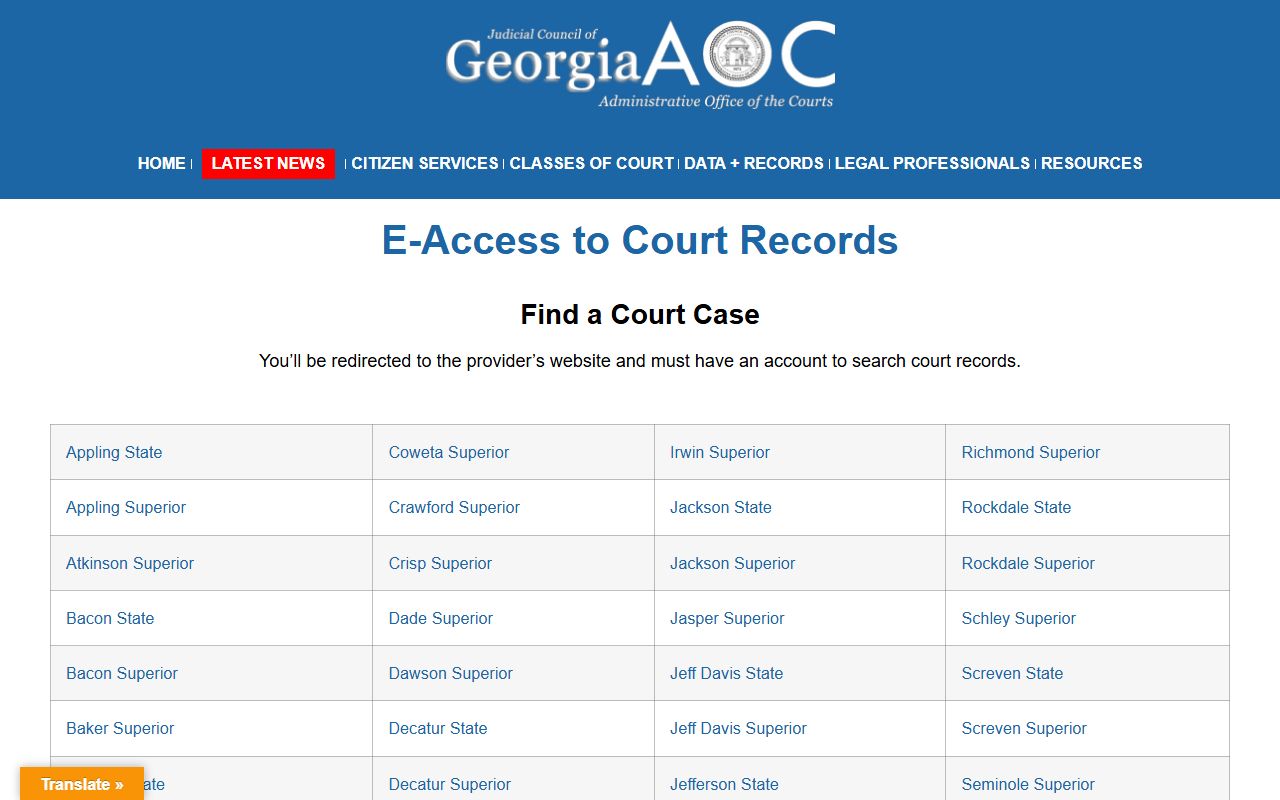
Use that directory to locate the Heard Superior provider link first, then keep the clerk contact information close for case copies or account-access problems.
| Channel | What It Covers | How to Use It |
|---|---|---|
| Georgia Courts E-Access | Official statewide court-provider directory | Find Heard Superior, then follow the PeachCourt provider link. |
| PeachCourt | Provider listed for Heard Superior | Use provider search tools after account access if required. |
| Clerk of Superior Court | Official Superior Court case files and certified copies | Call, visit, mail, or email the clerk for copies and routing. |
| GSCCCA Directory | State clerk contact verification | Confirm clerk name, court coverage, address, phone, and fax. |
| District Attorney | Felony prosecution decisions | Use for prosecution-process questions, not jail custody or defense advice. |
Heard County Court Records Search Fields
The Georgia Courts directory and provider route were only partly inspectable in the research record because PeachCourt access may require a login. That still gives enough detail to set the right expectations. A person looking up court records after a jail arrest should collect the defendant's full legal name, any court case number, the arrest or filing date range, and the court name before searching.
| Field Label | Type | Required | Options or Notes |
|---|---|---|---|
| County or court link | Directory link | Yes | Heard Superior is listed as a provider link to PeachCourt. |
| Account or login | Provider account | Yes or likely | Georgia Courts states users must have an account to search court records. |
| Party or name | Provider search field | Likely optional | Use the defendant's legal name, including middle name if known. |
| Case number | Provider search field | Likely optional | Use a case number from the jail, warrant, subpoena, clerk, or court notice. |
| Filing date or status | Provider filter | Unknown | Not verified for Heard Superior or PeachCourt during research. |
Names alone can be thin, especially when a person has a common surname or uses initials. If the portal search fails, ask the clerk whether the case has been filed, whether it is under a different court name, and whether the available record is a warrant, accusation, indictment, or final disposition. Juvenile matters and some restricted records may not appear in the same public path.
Steps After Heard County Jail Arrest
A court records after jail arrest search works best when it follows the same order as the local process. The first record is usually the booking or bond fact held by the jail. The court case may appear later, once a charging paper is filed or a case number is assigned.
- Start with Heard County Jail at (706) 675-3329 to confirm custody, arresting agency, available booking charge language, and whether bond has been set.
- Ask whether a court case number exists. Jail staff may not have a final case number right after the arrest.
- Use the Georgia Courts e-access directory to reach the Heard Superior and PeachCourt provider path, then search by name or case number.
- Contact the Clerk of Superior Court for felony filings, indictments, accusations, certified copies, older files, or case records that do not show clearly online.
- Contact the Coweta Judicial Circuit District Attorney's Heard office for prosecution-process questions about felony cases, not for legal advice or custody release.
- Use official criminal-history procedures for a broad statewide background report, because a single court file is not the same as a full criminal history.
That order keeps the records straight. Booking confirms the arrest and jail status. The court case shows what was filed. The prosecutor's later action shows whether the charge moved forward, changed, or ended.
Heard County Arrest Charging Documents
Formal court records after a Heard County jail arrest are driven by charging documents. A complaint or warrant-stage paper can start the process. An accusation is a prosecutor-filed charging document often used for non-indicted matters. An indictment is a grand-jury charging document and is often tied to felony prosecution in Superior Court. The title on the court file controls, so readers should rely on the clerk record rather than guessing from the jail booking label.
| Document | Who Files or Issues It | What It Means |
|---|---|---|
| Complaint or warrant-stage paper | Law enforcement, court, or prosecutor depending on stage | Can support arrest, first appearance, or early probable-cause steps. |
| Accusation | Prosecutor | Formal charge filed without using the indictment label. |
| Indictment | Grand jury | Formal charge, commonly tied to felony prosecution in Superior Court. |
| Information | Prosecutor or court-file process | Use the case-file title and clerk guidance because labels can differ. |
The Heard County District Attorney page places the office at 215 E Court Square, P.O. Box 730, Franklin, GA 30217, and lists (706) 675-0955. It says the office prosecutes people accused of felony crimes in the five-county Coweta Judicial Circuit. The Coweta Judicial Circuit District Attorney site names Herb Cranford as district attorney, and the Heard office hours are 8:00 AM to 5:00 PM with lunch closure from noon to 1:00 PM.
The source image from the Heard County District Attorney contact page documents the local prosecution office tied to felony charging decisions after an arrest.
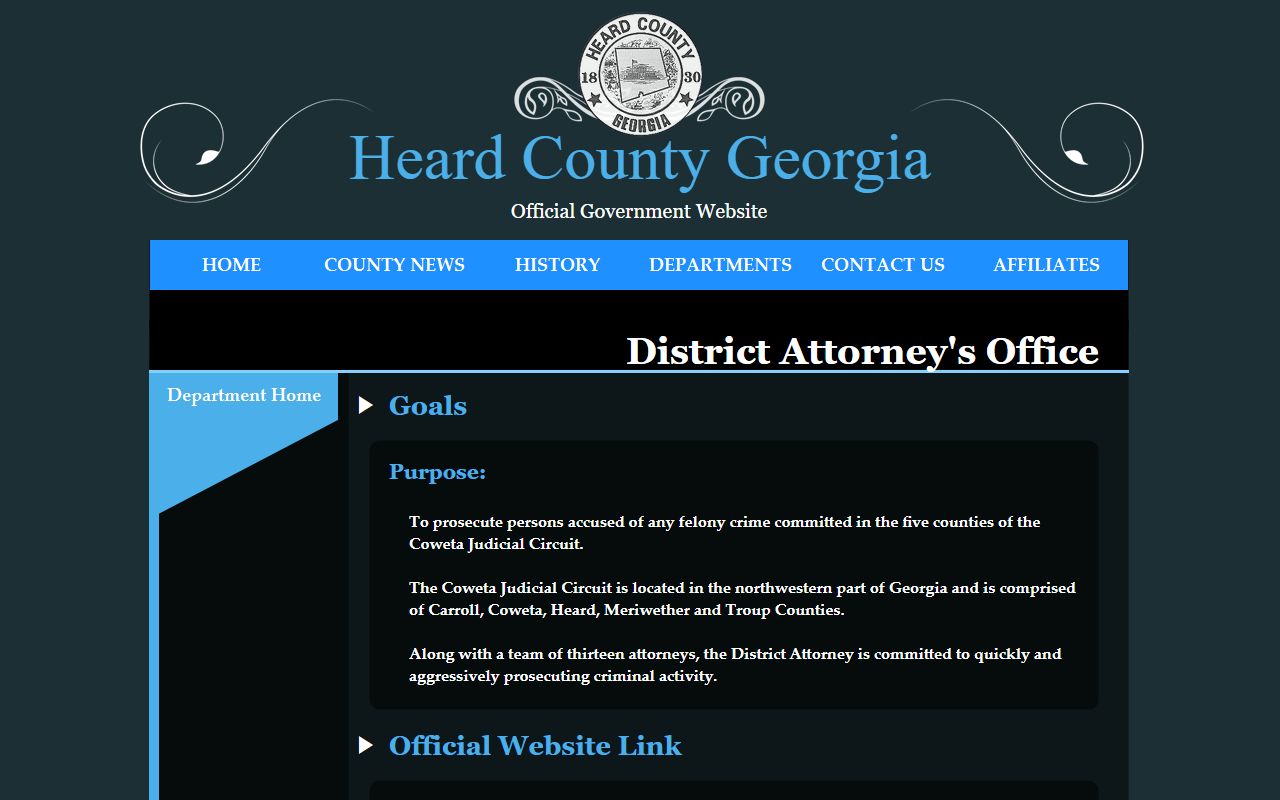
Use the DA contact for prosecution-role questions. Use the clerk or provider record for filed documents and court-certified copies.
Heard County Court Charge Status
A charge is not fixed just because it appeared at booking. The jail may have one label from the arrest, while the court file later shows an accusation, indictment, amended count, dismissal, or final disposition. Charge status should be read from the court case when a case is open, then confirmed with the clerk if a copy or legal proof is needed.
| Status | What It Means | Where to Confirm |
|---|---|---|
| Pending | The case or charge has not reached a final result. | Provider portal or Clerk of Superior Court. |
| Amended | The prosecutor or court changed the charge language or count. | Court docket and filed charging papers. |
| Reduced | A lesser charge replaces or resolves the original charge. | Court disposition, plea, or order. |
| Dismissed | The charge ended by court or prosecutor action. | Disposition entry or order from the clerk. |
| Nolle prosequi | The prosecutor declined to continue prosecution. | Court-file entry or prosecutor filing. |
| Conviction | A guilty plea, verdict, or court finding was entered. | Final disposition or certified court copy. |
Note: A booking charge can help identify the arrest, but the court disposition is the source for the legal outcome.
Bond Records After Heard Arrest
Bond records bridge the jail and the court. Heard County's official inmate bond page defines bond as something of value used to secure release from jail while the person awaits trial, with the condition that the person appear in court. The page is clear that judges set bond amounts, not the sheriff. Bonding personnel of the Sheriff's Office administer the process once a bond is allowed, and the sheriff's office home page identifies Ross Henry as Heard County sheriff.
Heard County lists cash, property, out-of-county property, and professional bond methods. During normal cash-bond business hours, Monday through Friday from 8:00 AM to 5:00 PM, USPS money orders or cashier checks drawn on local Heard County banks are required. After normal business hours, only USPS money orders or cash are accepted. Personal checks, business checks, and credit cards are not accepted for cash bonds at any time.
| Bond Type | Heard County Rule | Limit or Caveat |
|---|---|---|
| Cash bond | Full amount posted by accepted instrument. | No personal checks, business checks, or credit cards. |
| Property bond | Heard County property can secure release. | All owners on deed or tax receipt must appear with required documents and photo ID. |
| Out-of-county property bond | Prepared by the sheriff's office in the property county. | Must arrive at Heard County Jail sealed on the other county's letterhead. |
| Professional bond | Posted by a company authorized and registered in Heard County. | Another county's licensed company is not enough; Georgia law allows up to a 15 percent non-refundable fee. |
O.C.G.A. 17-6-15 is the local bond page's cited Georgia law for sheriff authority over acceptable sureties and bonding rules. A posted bond may still not produce release if a detainer, other-agency hold, no-bond order, or judge-only bond restriction controls custody. Ask which court or agency controls the hold before assuming payment will release the person.
Warrants Before Heard Court Records
No official Heard County Sheriff's Office active warrant search, warrant list, or most-wanted database was located in the research material. That means court records after a jail arrest should not be built around a public warrant lookup claim. A warrant can still be the reason for the booking, but the way to verify it is through official contact channels, not a local web database.
An arrest warrant is issued when a court finds probable cause for arrest. A bench warrant often follows a failure to appear or violation of a court order. A search warrant authorizes a search and is not the same as an arrest warrant. A fugitive warrant or hold can involve another jurisdiction that wants the person. Heard County Jail can confirm releasable custody facts at (706) 675-3329, the non-emergency report line is (706) 675-3328, and the Clerk of Superior Court can help route court-record questions.
Important: Anyone who believes an active warrant exists should consider legal advice before appearing in person at a jail or court office.
Heard Court Charges vs Convictions
A charge is an accusation in the court process. A conviction is a final result based on a guilty plea, verdict, or court finding. Court records after an arrest may show both, but the words do not mean the same thing. The difference is especially important when a person was booked into jail, posted bond, and later had a charge reduced or dismissed.
| Point | Charge | Conviction |
|---|---|---|
| Stage | Accusation or filed count. | Final plea, verdict, or finding. |
| Proof level | Can begin from probable cause or prosecutor filing. | Requires a resolved criminal case outcome. |
| Where it appears | Booking record, warrant, accusation, indictment, or docket. | Disposition entry, sentencing order, or certified final record. |
| How it changes | May be amended, reduced, dismissed, or nol prossed. | Changes only through later court action such as appeal, correction, or restriction. |
Georgia Access Limits on Court Records
Georgia's Open Records Act supports access to many public records. O.C.G.A. 50-18-70 defines public records broadly and states a public policy favoring open government. O.C.G.A. 50-18-71 covers inspection, copying, response timing, and fees. Agencies generally respond within three business days, but that does not always mean the record is produced in full within three days.
O.C.G.A. 50-18-72 lists exemptions. Law-enforcement and prosecution records can be redacted or withheld in some circumstances, especially when an investigation or prosecution is active. Medical facts, victim-protected information, juvenile records, sealed files, and restricted records may not be available through the same public route. A clerk record, sheriff record, and prosecutor file can have different access rules because each office holds a different type of record.
The source image from the GSCCCA Heard County clerk listing confirms the state directory details for the clerk office that manages Superior and Juvenile records.
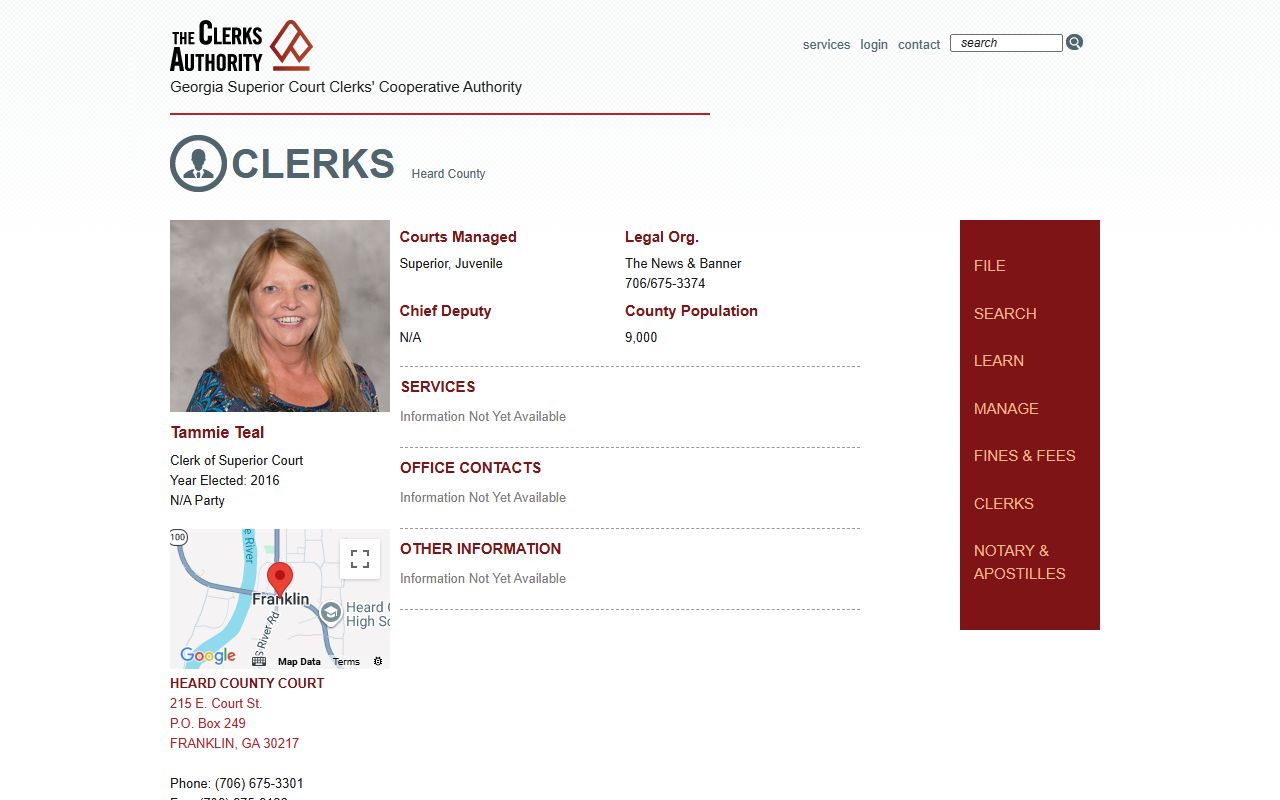
That directory is useful for contact verification, while the court provider and clerk office remain the practical routes for case access and certified copies.
Heard Arrest Records Restricted or Expunged
Georgia commonly uses the language of record restriction for limiting public access to eligible criminal-history information. Many people still say sealed or expunged, so the terms need care. A restricted record may be blocked from ordinary public view while still available to certain agencies. Expunged is often used in a broad, plain-language way to mean cleared from public access, but Georgia procedures and eligibility should be checked with the court, law-enforcement agency, or counsel.
| Point | Sealed or Restricted | Expunged |
|---|---|---|
| Public view | Hidden or limited for ordinary public access if the law allows. | Often used to mean removed or treated as cleared from public access. |
| Agency access | Law enforcement or courts may still have limited access. | Access depends on the exact order and Georgia law. |
| Common trigger | Dismissal, eligible disposition, juvenile protection, or court order. | Eligible cleared matters, depending on the legal process used. |
| Where to verify | Clerk, court order, and relevant law-enforcement agency. | Clerk, court order, and criminal-history authority. |
A dismissed charge does not always vanish from every system at the same moment. Check the court record for the disposition, then confirm whether jail, sheriff, or state criminal-history records need a separate restriction step.
Heard Court Records Routing
The best office depends on the exact record needed. Heard County Jail is the place to start for current custody, jail bond processing, and releasable booking facts. The Clerk of Superior Court is the route for filed felony case records, indictments, accusations, dispositions, and certified copies. The Coweta Judicial Circuit District Attorney controls felony prosecution decisions in the circuit, including Heard County felony cases.
| Record Need | Best Starting Office | Reason |
|---|---|---|
| Current jail custody | Heard County Jail | Jail staff can confirm releasable housing, release, and bond status. |
| Booking sheet or arrest record | Heard County Sheriff's Office open records | The sheriff created or maintains the jail booking record. |
| Felony case number | Clerk or PeachCourt path | Filed Superior Court cases are court records. |
| Indictment or accusation | Clerk of Superior Court | Official filed copies come from the court custodian. |
| Bond order | Court or jail, depending on stage | Judge sets bond; jail processes release. |
| Final disposition | Clerk of Superior Court | The disposition is a court record. |
Note: The DA office is a prosecution office, not a jail records desk and not legal counsel for a defendant.